Beer and the Scale of the Inhuman
I’ve noticed something about myself recently. Having moved from Pennsylvania (a state which has fairly restrictive laws governing the sale of beer) to Arizona (which does not), I’ve discovered that I have no idea how to shop for beer. Walking into Total Wine, for instance, I find myself overwhelmed with the, literally, thousands of beers they sell. While this is a great testament to the success of the American craft beer movement, it also provokes a bit of an existential crisis in me: how do you even narrow down to a preference in the face of always something new beyond the horizon?
In contrast to always coming home disappointed from Total Wine, I never seem to fail to find the beer I want to drink when I’m at a bar. With a selection of usually at most a dozen taps, I can almost always settle on a choice and a flavor that satisfies my fickle palate. The limitations imposed by a bar’s tap offerings does not exist in this Walmart of liquor, with its shelves and shelves and shelves of brightly labelled, subtly varied concoctions of malt, hops, and water.
Being a person who can never turn off his work brain, I realized that this sudsy conundrum relates to my current research project. Having finished my book on transhumanism, I’m preparing a contrasting volume on what I’m calling “inhumanism.” Both projects, as I conceive them, deal with counter-rhetorics to the current configuration of posthuman thought in the Western academy, a kind of philosophical stew of animal studies, affect theory, and object-oriented ontology. The transhumanism project counters this dominant rhetoric by amplifying the ethical ickiness of topics such as genetic engineering, body modification, and extropianism. The inhumanism project, in contrast, counters the posthuman idea of raising up animals to a flat plane of rhetorical agency by positing a worldview in which the human is pushed out of agency by increasingly autonomous forces of the inhuman—economics, global information flows, epidemiology.
As I want to specifically examine in this post, however, my beer problem is a much more minor (perhaps even “first world”) version of this inhumanism. The number of beers for purchase exceed my rhetorical capacities to make a choice. This paralysis is an encounter with the scale of the inhuman.
The Refrigerator’s Open But Nobody’s Home
While being unable to adequately match up my desires to bottles in the face of functionally infinite beer choice is certainly very different from the pernicious and autophagic conditions facing modernity in the era of inhumanism, I think they provide a concrete route toward something that is by nature diaphanous.
The real germination of this project was the debate surrounding TARP and the growing discussion amongst a number of bloggers and journalists at the time that one of the problems with the debate was that the numbers involved (say $1trillion) are simply too large for the human brain to comprehend and make rational decisions about. We simply have no way of knowing whether or not we are getting a good or bad deal because the math forces the rational parts of our brain to reset. Personally, I think this paralysis is really interesting from a rhetorical standpoint.
As one of my teachers likes to say, the condition of having infinite choice or infinite data or infinite money—basically experience something that exists on an inhuman scale—is the condition of standing in front of the fridge, with cool air rushing past your ankles, and having no idea what to eat. Your program of acquiring food, maybe even specific food items, is out of mind in the face of a warm glow and an array of delicious choice. This experience of inhuman scale only increases in our era of big data.
We simply have too many choices to do anything other than latch onto that same six pack of Four Peaks SunBru that we’ve been buying for a month—whatever, scaled up into an ontology, that means.
The Cramped Space of the Human
I brought up ordering a pint as a contrast to buying a six pack because unlike my consistent failure at retail beer buying, I think I am pretty good at working over a limited number of taps to get exactly the flavor I want. The philosophers Gilles Deleuze and Felix Guattari offer a philosophical construct to think through this condition in the age of the inhuman.
In their book on Franz Kafka, Deleuze and Guattari discuss the concept of a “minor literature,” works of fiction written by linguistically colonized individuals (Kafka was a Czech who wrote in German). These works, they argue, rewrite the colonizing language from within and make the personal inherently political. For Deleuze and Guattari, moreover, though, the explosion of creativity represented by this minor literature results from what they call “the cramped space.” In their thinking, the existence of writing from this minority position means that “the individual concern thus becomes all the more necessary, indispensable, magnified, because a whole other story is vibrating within it.” 1 This cramped space, is for Deleuze and Guattari, emblematic of the entire creative process, especially for Deleuze in his later works.
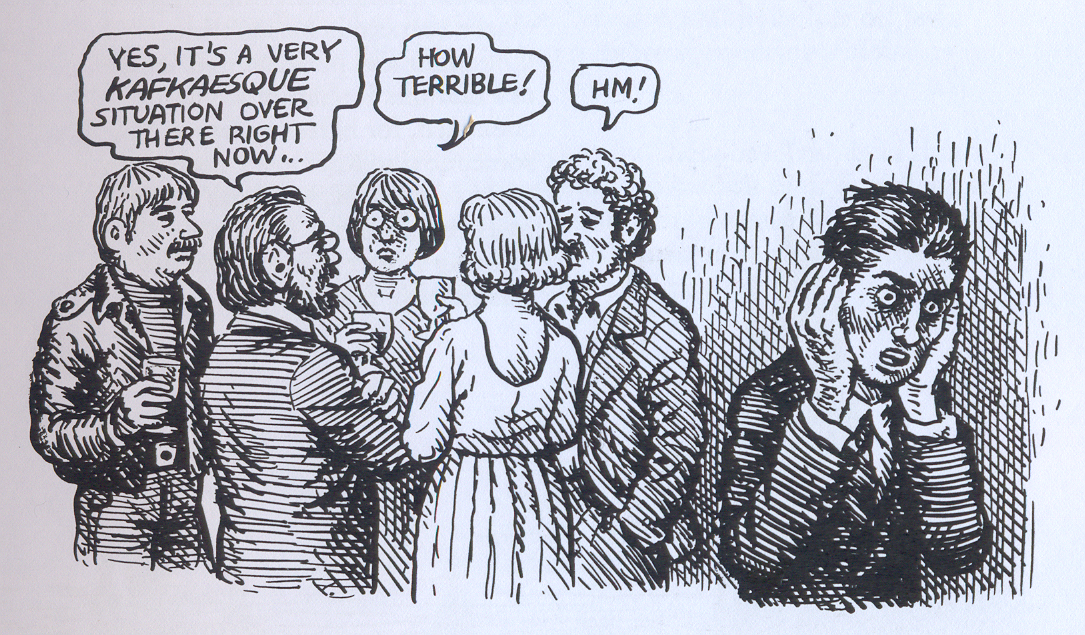
For instance, after Kafka, in an interview collected in Negotiations, Deleuze asserts that all “creation takes place in choked passages,” suggesting that his and Guattari’s original interest in the minor position has taken on a more universal position in his thought.2 Extrapolating from this movement, I think we can see that there is a general shift toward minoritarianism as a human condition (or at least, this is a thesis in the inhumanism book).
This shift to human minoritarianism—and a concomitant doubling down on cramped space construction in the form of a broadly-defined locavorism—darkly reflects the major rhetorical move of an animals-studies-inflected, posthuman thought: instead of ennobling the condition of the animal by considering them as equally lively and rhetorical, the inhuman lowers the agential potency of the human. I won’t get into it here, but in the book, I’m planning on reading the Freakonomics movement as an example of this (“humans act the way they do because of economics,” which ignores the fact that “economics” is itself a way of measuring and quantifying human behavior in the first place).
In any case, in the face of infinitely large data, I think we see the singularity of human consciousness beginning to function as a kind of cramped space in the sense Deleuze and Guattari meant it.
Survey Says: “Insignificant”
At the moment, the inhumanism book is entitled Eldritch Rhetoric; or, The Inhuman in Persuasion, and that brings me to the last thought for this post. I’m using a Lovecraft code word in the proposed title, because I see this book building up a rhetoric of the inhuman using the cosmiscist philosophy articulated in the fiction and non-fiction of horror writer H.P. Lovecraft. Lovecraft, more than any other author working in the weird American tradition, articulates a world of human insignificance and an active, inhuman malevolence flickering on the boundaries of consciousness. While a whole host of contemporaneous realist writers were documenting the meaninglessness of human struggle (not to mention Friedrich Nietzsche’s nihilism, influential on Lovecraft, in continental thought), Lovecraft’s dramatization of this insignificance specifically invokes the scale of the inhuman. Lovecraft’s narrators always go insane because the elder gods of his Mythos pantheon defy human comprehension. The non-Euclidian geometry and extra-human scale of their architecture and the attractive repulsiveness of their eldritch visages evoke a world in which the human is not only not central but not even capable of comprehending the forces shaping its existence.
This is, ultimately, the scale of the inhuman.
So, while moving to a kind of cosmic horror is perhaps escalating too quickly from a discussion of not being able to choose a six pack of beer, I hope that my choice of introductory anecdote can put a human face, as it were, on the inhuman rhetorical paralysis shaping the present. This idea of “a human face” is, of course, itself deeply suspicious but also, I think, necessary for beginning to think about the role of the inhuman in contemporary persuasion.